
For factories moving off spreadsheets
MRP Software For UK Precision Manufacturers
Know what you need to buy, what you can make with the people and machines available, and which orders are at risk. Keystone connects planning, shop-floor activity, quality and actual job cost in one system made and supported in Sheffield.
CNC-02 is double-booked. Two operations want the same machine at the same time, and the plan says so before the week starts rather than on the morning it matters.
Illustrative · synthetic data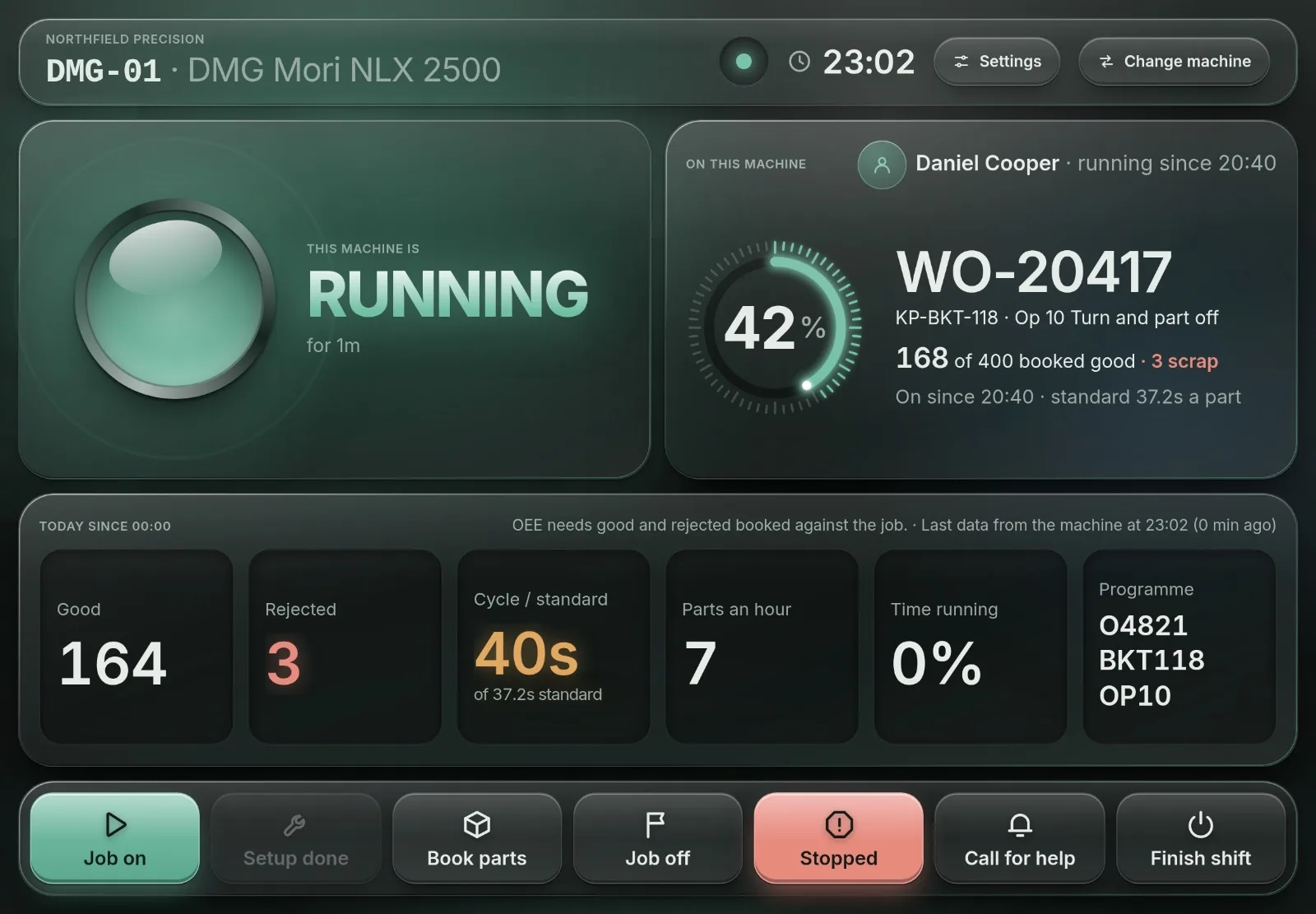
A Paperless Shop Floor
Less Paperwork. More Production.
Give operators job information on screen and record time, completed quantities and scrap at the terminal. Reduce printed job sheets, handwritten updates and retyping in the office.
What it does
Plan The Work Your Factory Can Actually Deliver
Connect customer orders, materials, available people and machine capacity. Follow each job through production, quality and despatch, with actual cost and the records behind every decision.
Plan Machines And People Together
Work centre calendars narrowed to the hours somebody is rostered, with unattended running counted separately and conflicts shown before the week starts.
Illustrative · synthetic dataBehind
Compare The Agreed Plan With Actual Progress
Publish a plan and follow confirmed progress against it. A job running late shows as slippage rather than quietly moving every commitment behind it.
Illustrative · synthetic dataKeep Quality Evidence With The Job
A measured result against its tolerance, the instrument it was measured with, and the calibration that stood on the day, kept on the record that released the parts.
Illustrative · synthetic dataCommon ground
Does Any Of This Sound Familiar?
Common operational problems, with links to the features that address them. Each one goes to the part of Keystone that deals with it.
A customer rings about an order and nobody can say where it is.
Every job carries its operations, its bookings and its holds. Open the order to see its operations, bookings and holds.
See how →You find out a part is short when the kit is picked.
Material planning shows when a shortage is expected and which order needs the material.
See how →The plan says the machine is free. Nobody is rostered on it.
Capacity is narrowed to the hours somebody is actually on the machine, with unattended running counted separately.
See how →You quote the next one from the last estimate, not what it cost.
Labour, material, overhead and subcontract land on the job that incurred them, so the next quotation starts from evidence.
See how →An audit lands and a fortnight disappears into finding records.
Inspections, concessions and material history are recorded as the work happens, not assembled afterwards.
See how →A machine stopped hours ago and nobody knows which order it hit.
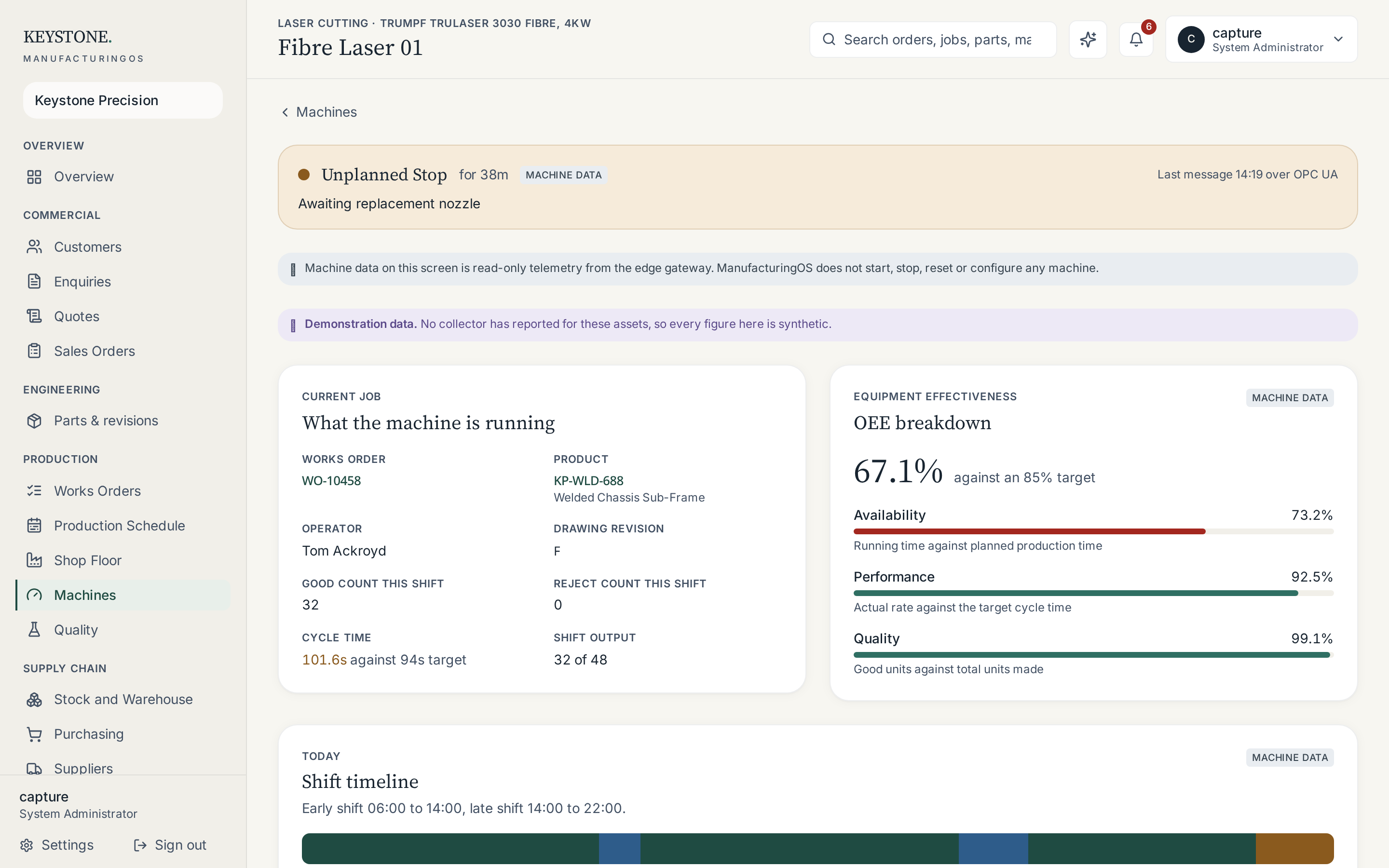
Machine state is read from the control and joined to the works order that was running, so you can review the affected job and its planned delivery date.
See how →One job, end to end
Follow A Single Order Through The System
The same order, seen at six points between the customer asking for it and the margin being known. This is a demonstration using fictional orders, parts and customers.

1.
Customer order
Sales order SO-2026-1844 — 600 units across two lines, 240 of them the motor mounting bracket, required 9 October. The promise date every later decision is measured against, and the delivery risk banner naming what threatens it.
2.
Material requirement
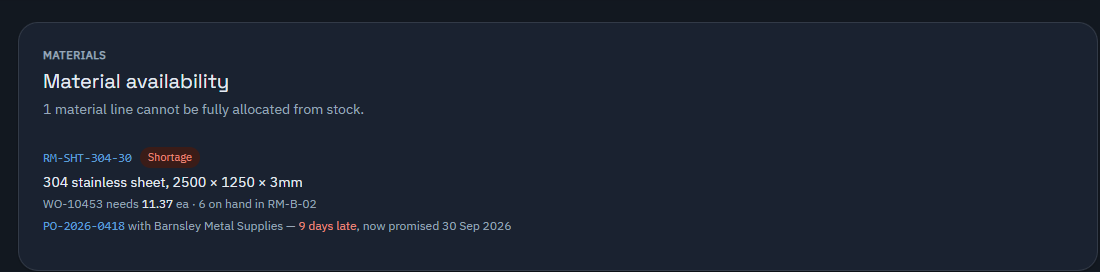
MRP nets the order against free stock and raises a buy recommendation. Eleven sheets of 3mm 304 stainless are needed and six are on hand. Keystone shows the shortage, the works order it belongs to, and the replenishment order that is nine days late.

3.
Schedule
Operations are placed on work centres across the horizon, with set-up and run distinguished and anything waiting on material or tooling held in the job pool rather than dropped on a machine that cannot start it.
4.
Shop-floor booking
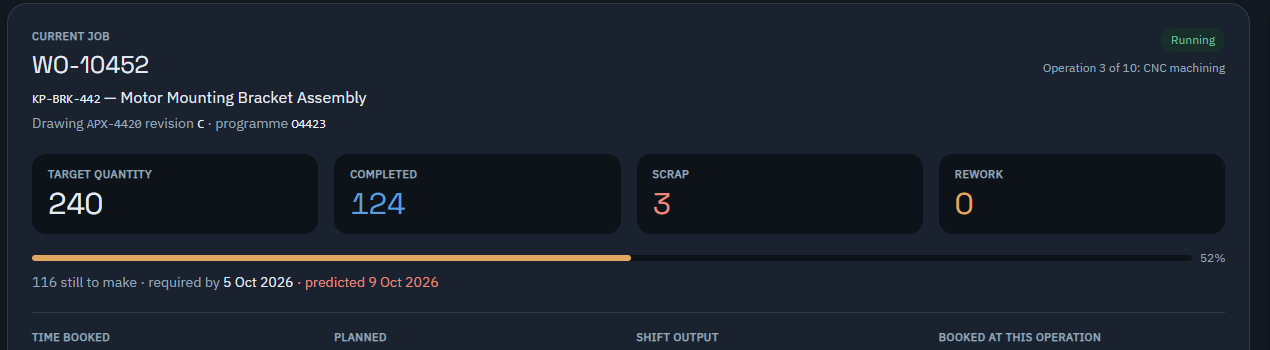
The operator signs in at the machine and books against the works order. 124 of 240 made, three scrapped, operation 3 of 10 — visible while the job is still running, not after it has shipped.
5.
Quality
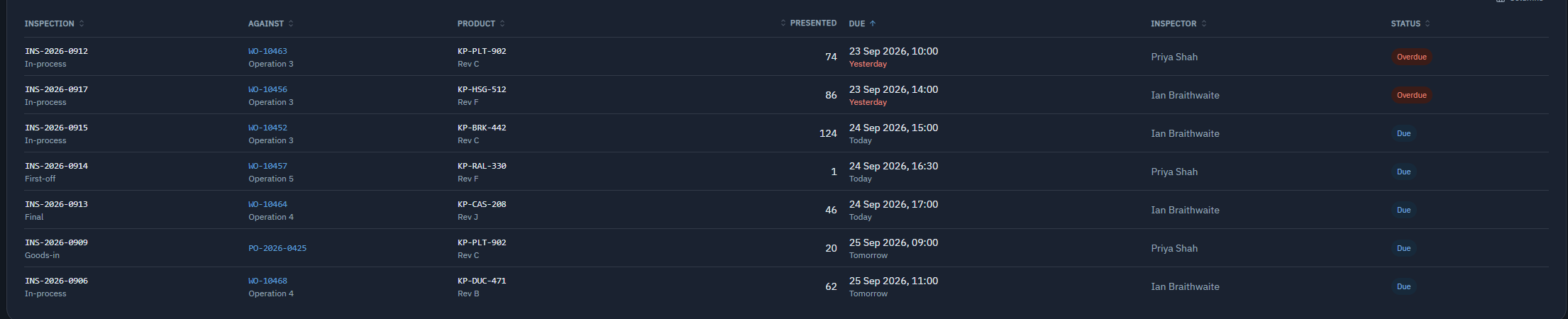
Inspection is queued against the job, not kept in a separate folder. The in-process check on WO-10452 names the revision, the quantity presented and the inspector who signed it.
6.
Actual margin
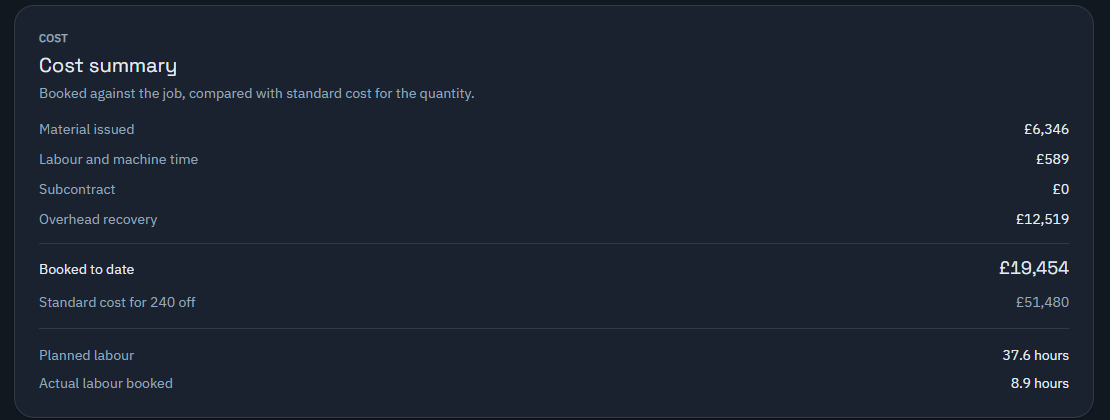
Material, labour and machine time, subcontract and overhead, booked against the job while it runs rather than totted up after it ships. £19,454 booked to date against a standard cost of £51,480 for the full 240, so the next quotation for this part starts from what the work actually took.
Two more questions come up every week. Which jobs are waiting for inspection or subcontract work? and what did that job actually cost? Both have a page of their own.
Production planning
Every Work Centre And The Jobs Assigned To It

Operational control
Answers For The Decisions That Shape The Day
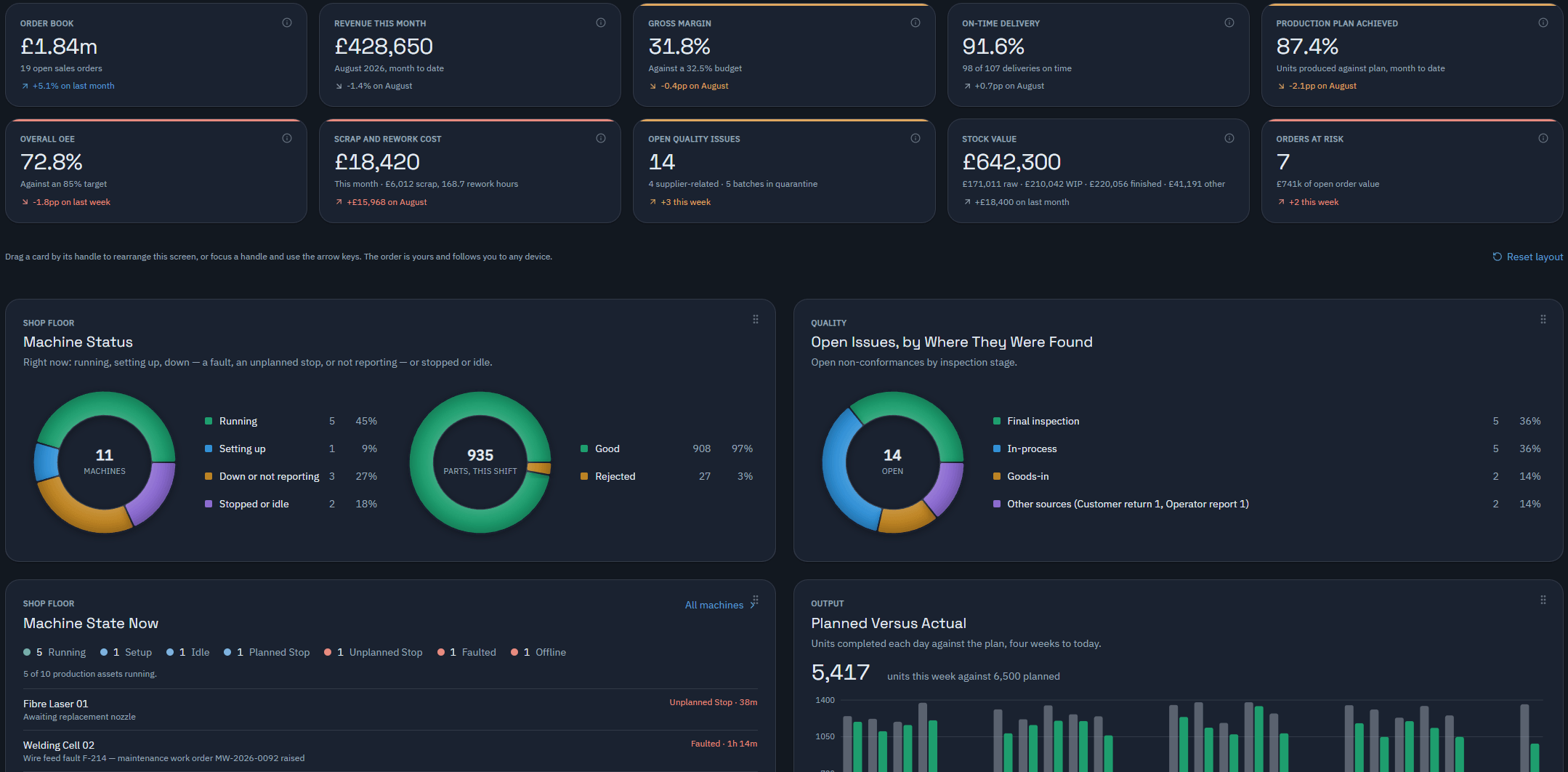
Keystone connects demand, materials, capacity, production, quality and cost so each answer comes from the same live record.
Which Of Your Orders Will Miss Its Date?
Keystone compares the promised date against the works order, the operations booked so far, the material still outstanding and any inspection holding the job. It returns the list, not a percentage. See production planning.
What Do You Need To Buy, And By When?
An MRP run nets accepted demand against stock, open production, issued purchase orders and requisitions, week by week. Every recommendation names the order behind it, so you can see why it wants you to buy. See material requirements planning.
See Overloaded Work Centres And Uncovered Shifts
The plan loads work centres against their calendars, then narrows each one to the hours somebody is rostered to that machine. Unattended running is counted separately, so a machine with no operator on it shows up before the week starts. See finite production planning.
Two more questions come up every week. Which jobs are waiting for inspection or subcontract work? and what did that job actually cost? Both have a page of their own.
Connected Factory
Machine Performance Linked To The Order It Affects
We install a small collector unit on your network. It reads machine state and ties each reading to the works order that was running. When a machine stops for four hours, you see which works order was running and assess the impact on its customer order.
Collection only reads. Nothing in Keystone can start, stop or change a machine. Not every machine can be queried, and what a control exposes varies by its age and interface. Tell us what is on your floor and we will confirm what we can read from it before you commit to anything.
One journey
A Connected History From Enquiry To Actual Margin
Each stage uses the same connected record, preserving the commercial and operational history of the job.
Keystone AI
Factory Intelligence That Identifies Risks Early
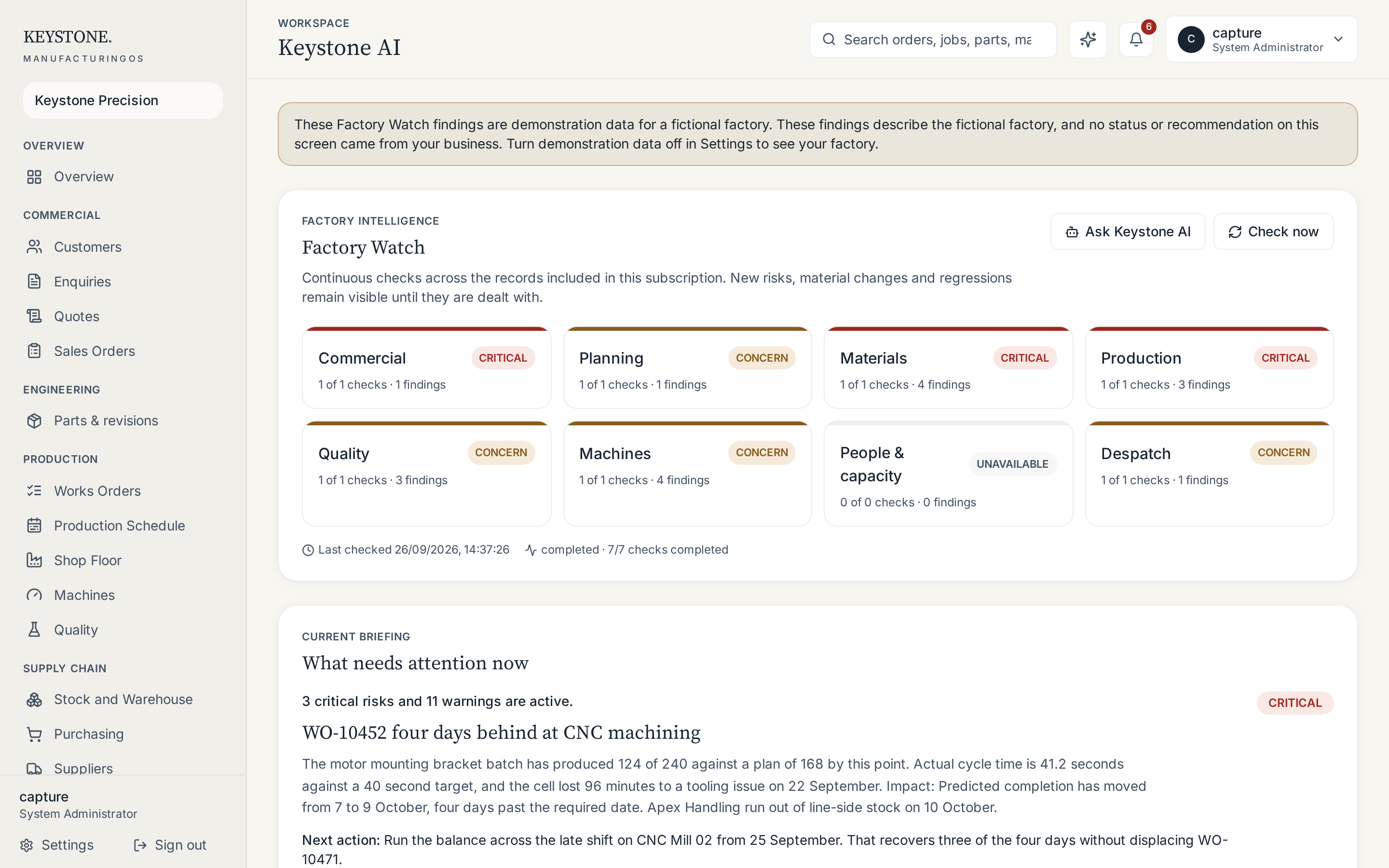
Factory Watch checks manufacturing records on a schedule and links each finding to the records behind it. Your team decides what action to take. Factory Watch checks eight areas of the factory record on a schedule: commercial, planning, materials, production, quality, machines, people and despatch. Each finding names the records behind it, carries a priority and an owner, and can be acknowledged, snoozed or actioned.
Each finding links back to the orders, jobs, materials or machines behind it, giving the responsible person the evidence needed to act.
Implementation
Implementation Led From Sheffield
There is no client software to install on office machines or shop-floor terminals. We work with manufacturers across the UK, beginning with on-site discovery and a clear view of how work moves through the factory.
We map the process, configure the system, import the data, validate it role by role, train each team, agree opening stock and open orders, then move to a controlled go-live. The implementation plan is prepared after discovery so it reflects the condition of the data, required integrations and number of sites.
Keystone runs manufacturing operations. The ledger stays where it is, telemetry stays read-only, and CAD and CAM stay in the tools your engineers already use.
Why Keystone
Built Around The Realities Of Precision Manufacturing
Planning
Keystone Plans Materials And Finite Capacity Together
The MRP run says what to make and buy and when. The finite plan then places that work on real work centres, narrowed to the hours somebody is rostered to the machine, with unattended running counted separately. Materials and capacity are planned against the same orders rather than in two systems.
Machine Data
Machine Data Tied To The Order
We read machine state from the control and join it to the works order that was running, so you can see which job was running and assess the delivery impact.
Security
Security Built Into Every Workflow
Keystone is developed and supported by Commstec IT Ltd, a Cyber Essentials certified and ISO 27001 aligned managed service provider. Security questions are answered directly, in detail, before you buy.
Scale
Starts Small, Grows With You
Built for factories of 25 to 150 people. Start on Core with orders, material requirements planning, machine planning, stock, warehouse working, despatch and actual job costing. Factory adds staffing-aware planning, quality control, People HR, controlled documents and engineering change. Connected Factory adds machine data. Nothing to install and updates are managed as part of the service.
Next step
See Keystone Precision With Your Manufacturing Workflow
A tailored walkthrough follows one of your jobs from customer demand through planning, production, quality and despatch.
£595
a month for Core. Prices for the three standard packages are published. Enterprise is quoted separately.
Unlimited
shop-floor users on every plan. Booking on to a job never counts against the office allowance.
25–150
the size of factory Keystone is built for, and the size we have designed every screen around.